

Truth: Caring can be draining.
But does it necessarily have to be? Can we find ways to notice our own dwindling energy reserves and replenish them as needed?
First and foremost, let’s establish the most important promise we must make to ourselves, which is to maintain connection to our own humanity. We must be aware of our own mortality, tenderness, perceived weakness, and inherent wholeness.
Now, this is an aspiration, constantly in flux, not a place we reach and remain. We flow (and sometimes flounder) along a continuum. The middle section is our safe zone while the extremes on either end, namely whether we’re completely drained or far too emotionally invested, are fraught with overwhelm.
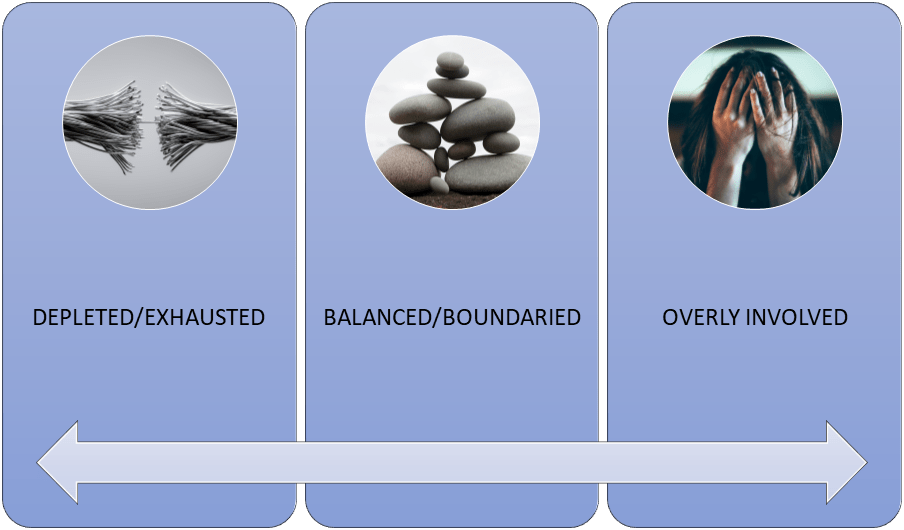
How can we aim for balanced and boundaried? How can we keep our hearts open—and actively engaged—while remaining steady in the face of another’s hardship?
It’s useful to remember to take it in without taking it on.
TAKING IT IN
When witnessing intensity, including expressions of anticipatory grief, regret, frustration, or challenging dynamics, we can safely, mindfully take that experience in. We can be present and calm. We can stay close when others might turn away or attempt to redirect the situation. We can listen attentively, providing people with space and silence to vent and lament. And we can even offer some feedback in the form of rewording or proposing ideas to consider, when beneficial.
Outside of client visits, we can take the experience into our minds and make it part of our regular practice of processing and introspection. We can see how it lands, watch how it feels, and notice what comes up for us as a result. The goals of “taking it in” are to (1) provide individualized care, (2) broaden our understanding of the human experience, and (3) frequently gauge our own need for nurturance.
TAKING IT ON
Conversely, taking it on would mean making it yours—namely, taking responsibility for figuring things out. For determining the “right” decisions on behalf of someone else. For solving and rescuing. It also can mean personally experiencing the feelings a client is enduring—fully absorbing and attempting to “be in their shoes” to try to gain perspective and build an alliance.
This is consuming.
Questions to Ask Yourself:
- Am I trying to change or “control” what’s happening?
- Am I being forceful with suggestions?
- Am I sacrificing my own needs to provide presence or care?
- Am I sharing too much personal information with my clients/patients?
- Am I feeling flooded with emotions and easily activated?
- Am I numb?
- Am I anxious?
- Am I feeling a sense of dread about my work?
Assess yourself gently and honestly, remembering that maintaining connection to your humanity is a process and a practice. After assessing, you may realize you require immediate, acute support in the form of medical or mental health care. You may find that adding in some acts of self-nurturance or time with loved ones to your schedule settles you back into a place of balance. Or you may celebrate your current status. Regardless, circumstances will likely fluctuate, and reassessments are vital.
Signs of Connection and Disconnection (examples)
CONNECTION:
- Feeling centered and self-aware
- Having clarity about what’s yours and what’s not (feelings, decisions, experiences)
- Being humble and open to learning
- Being forgiving with yourself and others
- Experiencing a wide range of emotion, including nervousness and awe at times
- Laughing, crying, and expressing frustration when appropriate
DISCONNECTION:
- Being guarded, walled-off, or robotic (going through the motions)
- Being rigid with an agenda or your expertise
- Assuming you know exactly how a visit will unfold ahead of time
- Experiencing uncontrollable emotions
- Needing to be consoled by clients/patients
With the looming prospect of disconnection and burnout, we each have to find our best way to remain in the “balanced and boundaried” zone. As you develop your method, consider the following essential components.
Intention, Action, & Mindset
- Set the intention to assess where you are on the continuum of connection with regularity and honesty. Perhaps add reminders to your calendar and also look for signs of depletion and over-exertion to cue a self-check.
- Take action to recalibrate and reset as necessary. You might reach out to sources of support and turn inward to access your inner strength and wisdom.
- Adjust your mindset as you consider how to frame your thoughts. What does this all sound like inside your head? How do you explain it to yourself or make sense of it? Sometimes the most effective strategy is questioning a reaction and then reframing it. Is this [emotion, decision, response] actually mine? What part of it might be mine? How might this experience inform the care I offer? Or the philosophies and beliefs I hold? Contemplation can lead to clarity.
Lastly, cultivate trust in the face of the unknown—trust in yourself, in your work, and in others. Repeat a related mantra, if helpful: The humanity in me honors the humanity in you.
Please take good care. The world needs your heart of compassion.

 Francesca Lynn Arnoldy
1 thought on “Vital Deathcaring: Maintaining Connection to our Humanity”