

First, please know, you are held in gratitude. Whether you are a clinician, faith leader, deathcare worker, life coach, volunteer, neighbor, or loved one, the support you supply to others is crucial. Without it, many among us would feel lonely and neglected.
So, thank you.
Caring for people through the end of life can become heavy and draining, though, if providers are not mindful of their reserves.
How can you support others, sustain yourself, and remain energized in your work?

Professional Care Providers
Throughout the process of grappling with mortality, many questions will arise. Due to your role, those you serve will look to you for suggestions—and even answers. Your patients or clients will seek your counsel regarding sensitive topics. Likely, you will have related information to share due to your knowledge of research and interventions in addition to your past work experiences. You are an expert in your field, which is undoubtedly beneficial, yet your patients or clients know themselves best. You must meld all sources of wisdom together to offer truly person-centered—ideally, person-led—care.
Consider these approaches:
- Instead of providing solutions, frame suggestions as options.
- Empower each patient or client to actively participate in discussing choices.
- Communicate not only the possible benefits and risks of an option, but also realistic expectations, and then ask the person you’re working with how it all sounds.
- Ask how well the options align with who they are and what they want.
As a provider, you can collaborate with those receiving your care to create customized approaches that honor every person’s uniqueness.

Making Suggestions and Sharing Stories
Making time for discussions as well as quiet listening are key approaches to compassionate care. Is it also appropriate for care providers to make suggestions or share stories? Yes—judiciously and with caution. It’s best to first allow someone time to talk without interruption. They might be able to come to their own conclusions. If additional information is warranted, how can you dispense it while promoting each patient’s or client’s sense of agency?
Before speaking, pause, WAIT (Ask, “Why am I talking?”), and ponder:
- Who is this share benefiting? Do I want a turn in the spotlight? Do I want to sound wise? Am I trying to fix or rescue this person?
- Am I attached to the outcome—to their decision? Am I pressuring my patient or client? Might they feel worried about disappointing me?
As a doula, when I feel compelled to share an example that is potentially helpful, I try do so in an anonymous, general way. If the story is from my personal life, I usually do not pose it as such. Instead, I might begin, “I know of someone who considered/benefited from…” or “I worked with someone who…” There are several advantages to this approach. First, by removing identifiers, I convey to my clients I will carry their experience forward with respect as I am demonstrating my commitment to confidentiality. Second, a neutral example leaves more room for clients to objectively consider the situation. It’s a more open, inviting approach.
In general, patients/clients appreciate:
- being seen as their true self,
- being heard and having their input genuinely considered,
- being treated as a partner in their own care, and
- having time to discuss next steps at any juncture.

Friends or Family Caregivers
As a friend or family member (chosen or biological), you can decide to either (1) move through death awareness exercises in advance of guiding your person through them or (2) complete them with your loved one side by side. You are both human. You are equals. You do not need to be an expert on all things related to life’s end. Instead, you can make time for important conversations, assist your person with brainstorming questions to ask during their appointments, and do your best to stay present and supportive as you work through exercises simultaneously.

What if time is short, but your person does not show interest in preparing? It is never our place to pressure or guilt someone into doing this work. We can be invitational though, which empowers individuals to maintain self-determination. This is hugely important as a serious illness tends to render someone increasingly dependent. People often feel quite powerless against the force of a terminal diagnosis. Sensitivity to this effect is paramount.
How, then, can we be invitational? Perhaps by focusing on ourselves first. Death awareness work is for any adult at any point. Instead of inquiring about your friend or family member’s preferences, ask to discuss your own fears and wishes; for example, “I know talking about advance care planning isn’t easy, but I’ve been thinking about my own preparations lately, and I’d like to share them with you if that’s okay.” If the person is agreeable, it can open further communication or at least get them thinking about matters related to their care.

Tips for Supporting Others Through Death Wellness Work for Any Care Provider or Partner:
- Get as clear as you can on your own planning. Formulating your own preparations for life’s end will help you clarify priorities and enable you to create ample space for someone else’s process.
- Continually revise your end-of-life forms. With time, your relationships and perspectives will change. Regularly assess what you have written to ensure it is up to date. You might commit to revisiting forms on your half-birthday, on New Year’s Day, or on National Healthcare Decisions Day (United States) every April 16.
- Respect each person’s distinct pacing. When faced with an intense, pressing reality, we tend to lean into it at certain moments and turn away at others. This is a built-in, protective mechanism that fosters emotional health. Forcing someone to accept what feels overwhelming about their situation can damage their well-being and any trust you’ve built.
- Care for others with patience and compassion. Even though you are also mortal, it is imperative to understand that a terminal disease brings people into a different headspace. While you might have strong feelings about certain care decisions, they are largely theoretical, while the other person’s experience is unfolding in the present moment with much more urgency. Please keep this distinction in the background of your mind.

Please take good care of yourself. Make sure to treat yourself with the same boundless kindness you offer to those around you, so you can cultivate and sustain an ample capacity to care.
Excerpted from: The Death Doula’s Guide to Living Fully and Dying Prepared
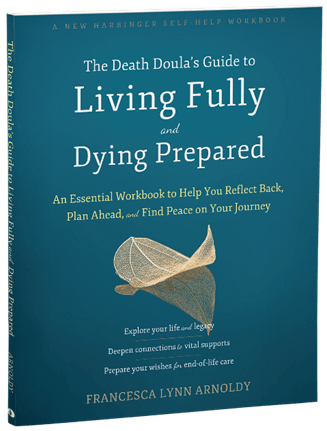
In this thought-provoking publication, community doula and death literacy advocate Francesca Lynn Arnoldy offers readers a guided tour through topics like death anxiety, mortality awareness, compassion, and connection. This contemplative workbook is geared toward anyone wanting a more intentional approach to living and dying as well as those beginning or updating their end-of-life plans, those with serious/terminal conditions, people ready to create remembrance gifts for loved ones, and deathcare providers seeking more tools. It includes personal stories, professional anecdotes, and practical activities throughout with sensitivity to all belief systems, cultures, identities, and histories of lived experience—inviting readers to modify and customize as needed to ensure alignment.

 Francesca Lynn Arnoldy